Coastal engineering
In short: A seawall is a structure that protects land from erosion by waves and currents. It is engineered for a chosen design storm and design life, with its toe below the expected scour. In NSW, anyone other than a public authority needs development consent to build or repair one, and consent conditions must secure funded maintenance, and beach restoration if the works increase erosion.
Key takeaways
- In Wamberal concept designs, a sloping rock revetment was cheaper to build but about 23 m wide; a vertical wall was about 1 m.
- Wamberal's design requirements set a minimum 50-year design life, and a scour level no higher than 2 m below Australian Height Datum without supporting studies.
- Toe failure from undermining by waves and currents is the most common cause of failure of coastal protection works that are not properly designed.
- On the Central Coast, all private coastal protection works, including seawalls, need development consent, and Council has resolved they must be privately funded.
- Under section 27 of the Coastal Management Act 2016, consent conditions must arrange funded maintenance, and beach restoration if the works increase erosion.
Seawall cracked, leaning or losing rock? Get a quote or call 02 4326 9026, and send photos of the wall, its base and both ends.
What is a seawall?
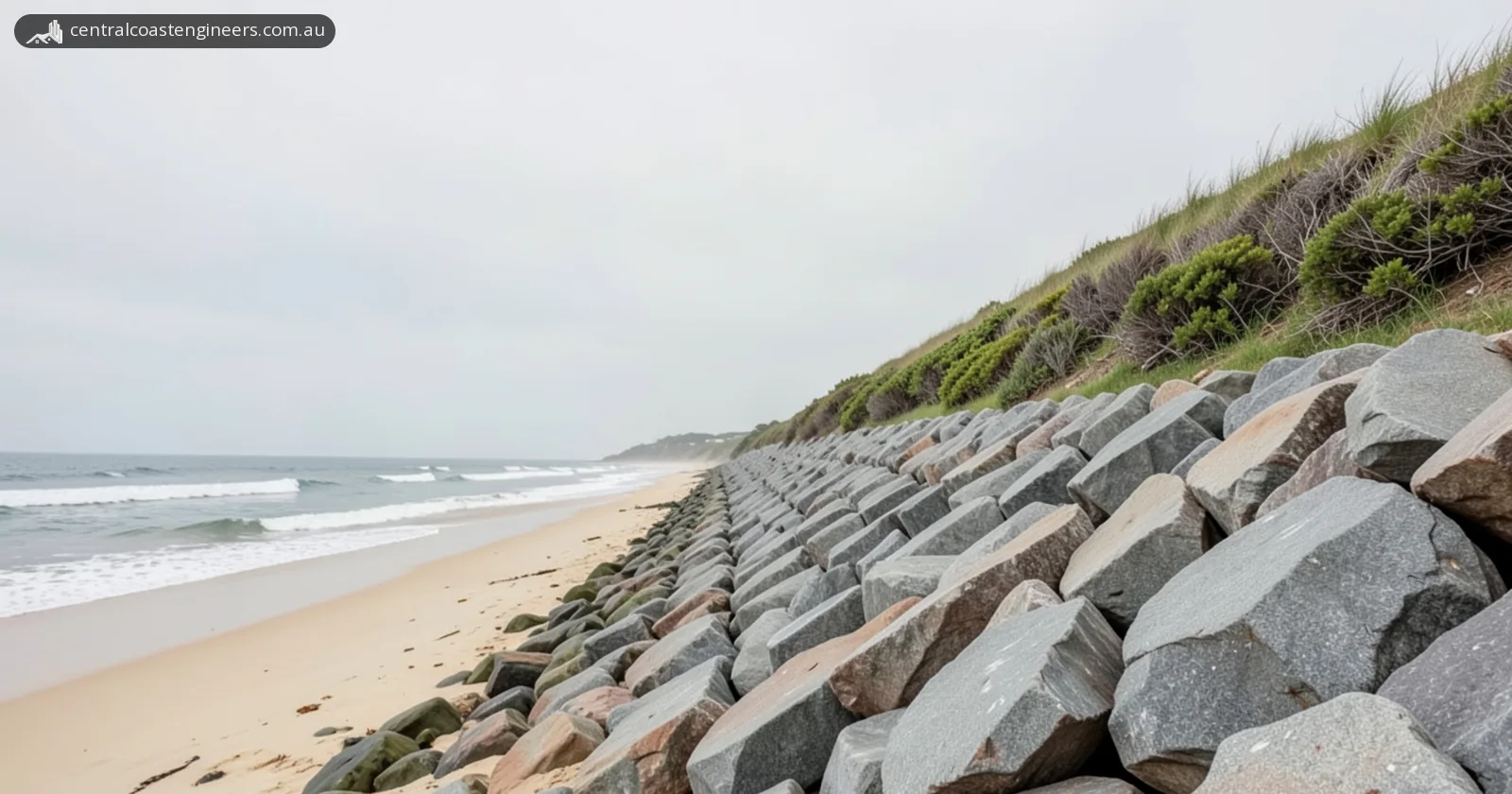
A seawall is a structure that separates land from water, protects the land from erosion by waves and currents, and holds back the fill behind it. That is the definition used by Manly Hydraulics Laboratory (MHL), the NSW Government's specialist coastal adviser. The NSW Environmentally Friendly Seawalls guide counts both sloping rock revetments and solid vertical walls as seawalls.
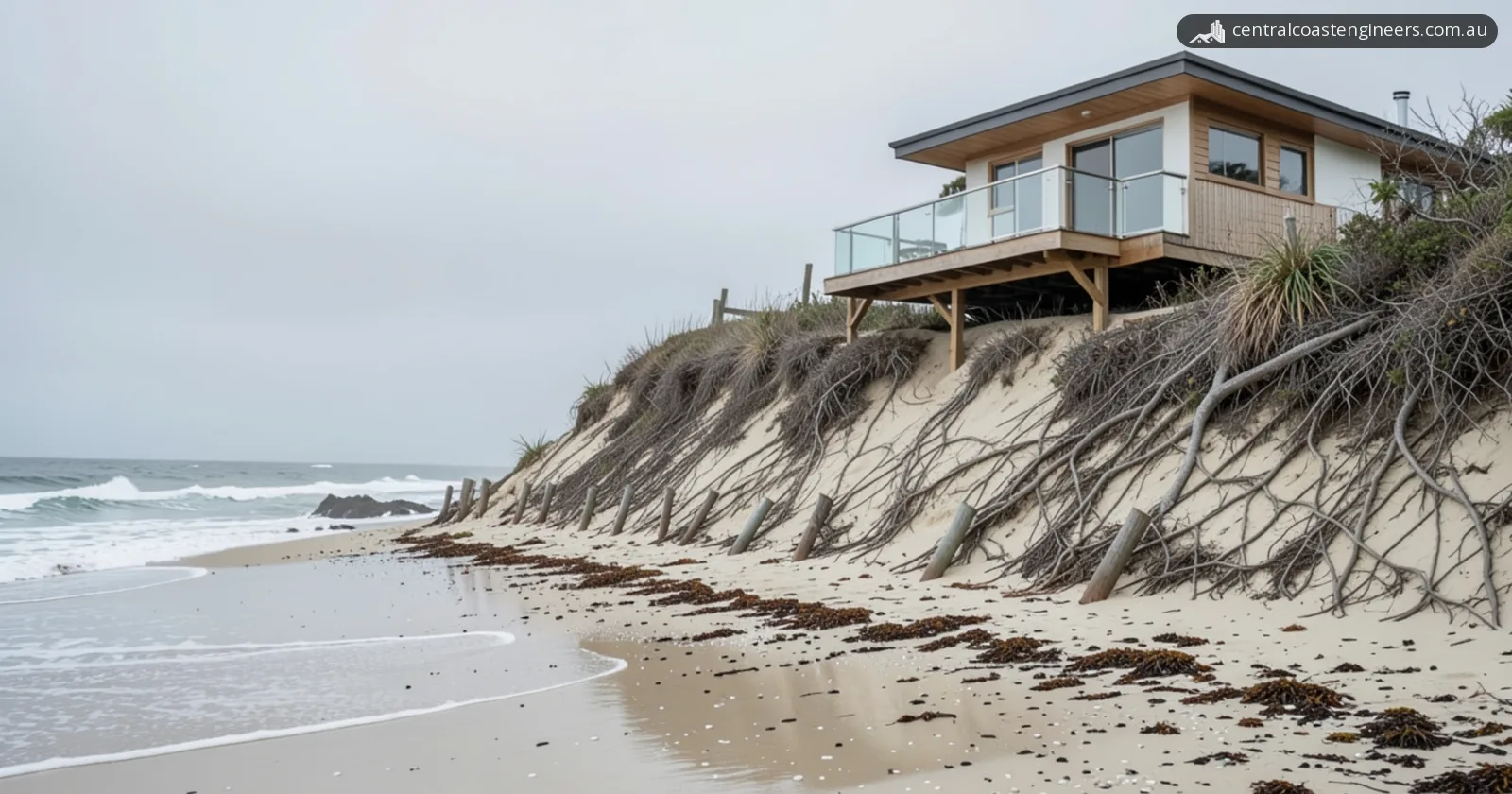
The Coastal Management Act 2016 classes seawalls, revetments, groynes and beach nourishment as coastal protection works. NSW Planning's fact sheet says these works protect assets during a storm of a specified size, need ongoing maintenance, and can cause erosion or accretion elsewhere. For how erosion itself affects homes, see our guide to coastal erosion on the Central Coast.
What types of seawall are there?
Seawalls are either sloping, like rock revetments, or vertical, and composite designs combine the two. Central Coast Council's Open Coast Coastal Management Program (CMP) shows local examples: a sandstone block seawall at Terrigal Haven, a rock seawall at Patonga and a rock revetment at the Avoca Beach surf club.
MHL's 2021 concept study for Wamberal Beach compared five options; the two basic types were (levels relative to the Australian Height Datum, AHD):
| Wamberal concept (MHL, 2021) | Sloping rock revetment | Vertical seawall |
|---|---|---|
| Construction | Two layers of basalt or sandstone armour rock on a 1V:1.5H slope | Precast concrete panels between H-columns, on piles, with a sheet pile toe |
| Toe level | -1 m AHD, with a berm scour apron | -3 m AHD |
| Width across the beach | About 23 m | About 1 m |
| Advantages | Lower cost; conventional, non-rigid design | Smallest footprint; low beach encroachment |
| Disadvantages | Wide footprint; reduced beach width; higher maintenance | Moderate to high cost; vertical drop after storms, a safety concern; more reflected wave energy in storms, limited in time and extent |
| Capital cost estimate | About $18,400 to $19,500 per metre | About $25,000 per metre |
| Maintenance estimate, whole beach | About $250,000 to $265,000 a year | About $34,000 a year |
These are preliminary 2021 estimates for a structure about 1,360 m long, excluding sand nourishment. The CMP stresses the options are concepts only.
How is a seawall engineered?
A seawall is engineered to survive a chosen design storm over a set design life, with its toe below the expected scour and its crest set to limit wave overtopping. The Wamberal Beach Engineering Design Requirements, prepared by MHL and adopted by Central Coast Council in October 2022, require:
- Design life and storm: at least 50 years, with a minimum design average recurrence interval (ARI) for failure of 500 to 2,000 years.
- Waves: the concept 100-year ARI storm has an 8.7 m offshore significant wave height (3-hour storm) and an ocean water level of +1.46 m AHD, excluding wave setup and sea level rise.
- Toe and scour: a design scour level no higher than -2 m AHD unless studies support another. MHL notes that toe failure from undermining is the most common cause of failure of coastal protection works that are not properly designed.
- Crest: set by a qualified engineer for wave runup and overtopping, and confirmed by physical modelling unless adequate factors of safety are shown.
- Ground: a geotechnical investigation with at least three test pits along the alignment.
- Materials: rough, angular armour rock, individually placed with at least three points of contact. Concrete and steel follow AS 4997-2005, which Standards Australia replaced with AS 4997:2026, Maritime structures, in May 2026.
- Drainage: return flows from overtopping and rainfall. MHL notes groundwater pushes on the back of a seawall unless drainage relieves it.
- Ends: terminal end controls to protect neighbouring properties from end erosion, where storm waves get behind an exposed end of a seawall and can collapse it from the landward side.
Do you need approval to build a seawall in NSW?
Yes. Under section 2.16(1) of State Environmental Planning Policy (Resilience and Hazards) 2021 (the Resilience and Hazards SEPP), anyone other than a public authority may build coastal protection works only with development consent.
On land directly next to, or under the waters of, the open ocean, an estuary entrance or the entrance of a coastal lake open to the ocean, a private seawall is regionally significant development under Schedule 6 of State Environmental Planning Policy (Planning Systems) 2021, unless the certified CMP identifies it. Since 16 January 2026, new regionally significant applications on the Central Coast are determined by the Central Coast Local Planning Panel on behalf of the Hunter and Central Coast Regional Planning Panel. Council is the consent authority for other private coastal protection works.
Section 27 of the Coastal Management Act 2016 bars consent unless the decision-maker is satisfied that, over the life of the works:
- they won't unreasonably limit public access to, or use of, a beach or headland;
- they won't pose a threat to public safety;
- consent conditions secure the works' maintenance, and restoration of the beach if the works increase erosion.
Section 2.12 of the SEPP adds a further test: the consent authority must be satisfied the development is not likely to cause increased risk of coastal hazards on that land or other land.
A public authority, such as a council, may work without consent on works identified in the certified CMP, beach nourishment, sandbags for up to 90 days, or routine maintenance and repairs. From 4 May to 1 June 2026, NSW Planning exhibited proposed changes that include extending consent-free sandbag placement by public authorities from 90 days to up to a year, and clarifying where coastal protection works are regionally significant. Confirm the current rules before you lodge.
What are the seawall rules on the Central Coast?
On the Central Coast, a private seawall needs development consent and is assessed against Council's certified Open Coast CMP and Chapter 3.2 of the Central Coast Development Control Plan 2022 (DCP).
- The CMP. Certified on 17 June 2026, it covers about 80 km of open coast from Box Head (Killcare) to Snapper Point (Budgewoi), but not The Entrance channel or Tuggerah Lakes. Owners may still lodge a development application (DA) for works on their own land, assessed on its merits. Citing the Coastal Crown Land Guidelines, it says private structural coastal protection works on the open coast should be wholly within the property they protect.
- The DCP. In the northern area (the former Wyong local government area), seawalls protecting existing private assets from coastal recession are considered on merit. In the southern area (the former Gosford local government area), structures in a coastal hazard area must not increase any coastal hazard and must be set back as far landward as practicable.
- Wamberal. The design requirements put the seawall as far landward as possible, on private property where possible, built, owned and maintained by the owners. In June 2026 the Hunter and Central Coast Regional Planning Panel refused all three DAs for a terminal protection structure there. The CMP's strategy is sand nourishment underpinned by a rock revetment or hybrid rock revetment.
- Ministerial authorisation. Under section 68 of the NSW Reconstruction Authority Act 2022, the Minister can authorise development without planning approval in a declared reconstruction area affected by a disaster, when the Reconstruction Authority's chief executive asks. At Council's request it was used for temporary coastal protection works at The Entrance North in 2025, and in July 2026 Council lodged an updated request for sand nourishment underpinned by a sloping rock revetment at Wamberal.
How is a damaged seawall repaired?
A damaged seawall is repaired by inspecting it to find what failed, then replacing displaced armour or rebuilding damaged sections to an engineered design. The Wamberal requirements and the CMP point to these steps:
- Inspect after major storms. For the Wamberal rock revetment concept, the CMP expects visual inspections after storms, with armour topped up or replaced only if displaced.
- Find the cause, such as undermining at the toe, erosion behind the ends or poor drainage.
- Follow the maintenance plan. At Wamberal, a qualified coastal engineer prepares it and Council approves it.
- Certify structural repairs, and send Council a copy of the certification.
Only public authorities may carry out routine repairs without consent. NSW Planning's fact sheet says private owners need development consent for coastal protection works, short or long term, so ask Central Coast Council before repairing a private seawall.
When to call a structural engineer
Call a structural engineer when a seawall on your land is cracked, leaning, undermined or losing rock, or when you are preparing a DA for one. Typical triggers:
- after a storm, armour rock has moved, the toe is exposed or the ends have eroded;
- concrete or steel in an older wall is cracking or corroding;
- you are buying a waterfront home protected by a seawall;
- your DA is in a southern coastal hazard area, where the DCP asks for coastal, geotechnical and structural engineering reports.
Our structural design and consultation service covers retaining wall drawings and structural remedial design, and our inspection reports include retaining wall inspections.
Frequently asked questions
How long does a seawall last?
Manly Hydraulics Laboratory, the NSW Government's specialist coastal adviser, says seawalls are typically designed for 40 to 60 years but may be designed for longer. It adds that maintenance is required over the design life.
Who pays for a seawall on the Central Coast?
The owners it protects. The certified Open Coast Coastal Management Program proposes that owners of properties at risk of coastal erosion continue to be responsible for funding and carrying out coastal protection works for their own properties. Section 27 of the Coastal Management Act 2016 lets funding for maintenance and beach restoration be secured by a bond or other legally binding obligation, or by an annual charge paid to the council.
Can I repair or extend an old seawall that was never approved?
Not without approval. The NSW Government lists replacing or improving existing unauthorised coastal protection works as unauthorised works. Councils and other consent authorities can respond with orders, fines or official cautions, and prosecution in court, which can bring fines and criminal convictions for the most serious offences.
Is a seawall the same as a retaining wall?
Not quite. Like a retaining wall, a seawall holds back the fill behind it, but its main job is to stop waves and currents eroding the land, so its design must deal with wave attack and scour at its base. In NSW it also counts as coastal protection works, which have their own approval rules.
Sources
- NSW legislation: Coastal Management Act 2016
- NSW legislation: State Environmental Planning Policy (Resilience and Hazards) 2021
- NSW legislation: State Environmental Planning Policy (Planning Systems) 2021
- NSW Department of Planning: Coastal Management SEPP fact sheet 3, Coastal protection works
- NSW Department of Planning: Resilience and Hazards SEPP
- NSW Environment and Heritage: Compliance in the coastal zone
- Central Coast Council: Central Coast Open Coast Coastal Management Program (certified 2026)
- Central Coast Council, Your Voice Our Coast: Open Coast Coastal Management Program
- Manly Hydraulics Laboratory for Central Coast Council: Wamberal Beach Terminal Protection Structure Engineering Design Requirements (MHL2872, 2022)
- Manly Hydraulics Laboratory for Central Coast Council: Wamberal Terminal Coastal Protection Assessment, Stage 3, Seawall Concept Design Options (2021)
- Central Coast Council: Development Control Plan 2022, Chapter 3.2 Coastal Hazard Management
- Central Coast Council: Coastal Erosion, Wamberal Beach
- NSW Planning Portal: Coastal Protection Works (Seawall), Section A, Wamberal
- NSW Planning Portal: Coastal Protection Works (Seawall), Section B, Wamberal
- NSW Planning Portal: Coastal Protection Works (Seawall), Section C, Wamberal
- NSW Department of Planning, Housing and Infrastructure: Changes to the planning panel system in NSW (fact sheet, January 2026)
- NSW Department of Planning, Housing and Infrastructure: Explanation of intended effect, Improving coastal management and supporting blue carbon and ecosystem restoration projects (May 2026)
- NSW Reconstruction Authority: Temporary coastal protection works at Entrance North
- NSW Department of Environment and Climate Change: Environmentally Friendly Seawalls (2009)
- Standards Australia: AS 4997:2026, Maritime structures