Inspections
In short: After storm damage, keep clear of any roof or balcony hit by a fallen tree, branch or large debris: NSW SES warns it may be structurally weakened even with no obvious damage. Call NSW SES on 132 500 for urgent help, photograph the damage and lodge an insurance claim. Before permanent repairs, have damaged structures assessed by a qualified professional, such as a structural engineer.
Key takeaways
- NSW SES says a roof or balcony struck by a fallen tree may be structurally weakened, even if there is no obvious damage.
- Call NSW SES on 132 500 for a damaged or leaking roof, or a tree that may fall on your property.
- Speak to your insurer before authorising any building work, including emergency repairs, and photograph the damage before cleaning up.
- For major home damage, Legal Aid NSW says insurers usually send an assessor, builder or engineer, and you can ask for their reports.
- Under the Codes SEPP, structural repairs after a declared natural disaster are exempt only as temporary works to make the building safe.
Storm or tree damage to your home on the Central Coast? Get a quote or call 02 4326 9026, and send us photos of the damage and your insurer's claim details.
What should you do first after storm damage to your house?
After storm damage, your first job is to keep everyone clear of the damaged part of the house and get emergency help if it is needed. NSW SES lists these steps for after a storm: check your house or property for damage, follow health and safety advice, avoid fallen power lines, and seek professional assessments from qualified assessors for any damaged structures, electrical items and insurance.
The NSW Government's recovery advice adds:
- Don't enter a damaged building or structure unless authorities tell you it is safe.
- If the house is damaged or unsafe, you may not be able to stay there. Secure it and call Service NSW on 13 77 88 to organise temporary accommodation.
- Take care around electricity, gas and water, and shut off damaged utilities.
- If you can still live in the house but critical repairs are needed, take photos of the damage and save receipts for anything you spend on repairs.
NSW SES says that in its last storm season it responded to more than 23,400 incidents, roughly 7,000 of them involving fallen trees and more than 6,500 involving leaking and damaged roofs.
When should you call NSW SES on 132 500?
Call NSW SES on 132 500 when a storm leaves your roof damaged or leaking, a fallen tree blocks access, or a tree may fall on your property or driveway. NSW SES attends the most urgent calls first. If anyone is trapped or injured, call Triple Zero (000).
NSW SES volunteers give temporary help to keep your home and situation safe. For permanent repairs, NSW SES says to contact your insurance company or a private contractor. For fallen power lines, NSW SES says to call your local energy provider, always assume the lines are live, and stay at least 8 metres clear.
What are the signs of structural damage after a storm?
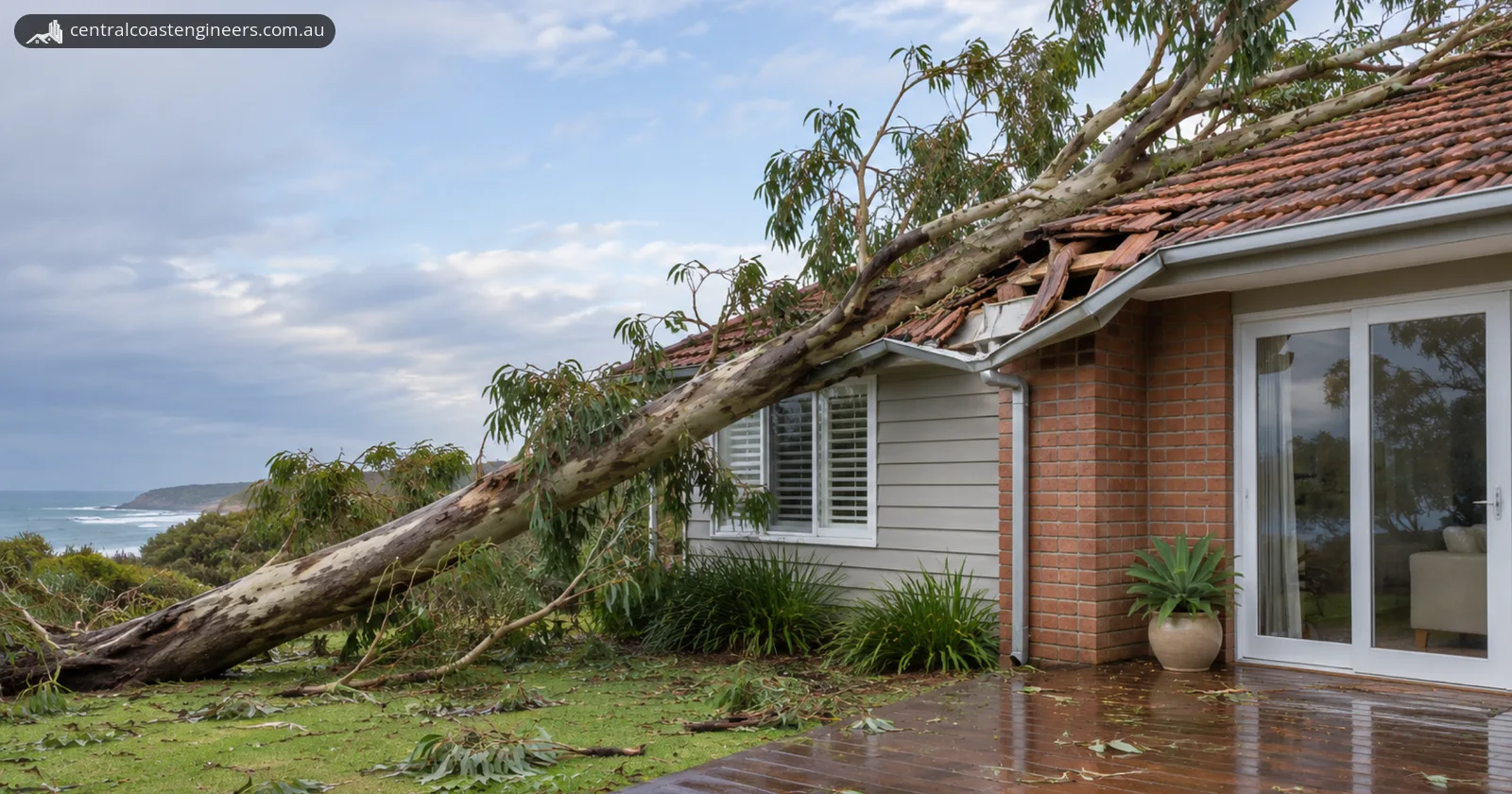
The signs of storm damage to check for include a roof or balcony hit by a tree, which NSW SES says may be structurally weakened, and the checks QBE lists for structural damage: missing tiles, lifted roof sheeting and damaged or cracked windows and doors. QBE adds that sagging, cracks or nail pops in ceilings and walls can indicate water damage. Some damage is hidden. NSW SES warns that if your roof or balcony is struck by a fallen tree, branch or other large debris, it may have been structurally weakened, even if there is no obvious damage.
| What you see | What it may mean | What to do |
|---|---|---|
| Tree, branch or large debris on the roof, deck or balcony | The roof framing or balcony may be weakened, even with no obvious damage (NSW SES) | Stay clear, call 132 500, and have it assessed before anyone goes on it |
| Missing tiles or lifted roof sheeting | Roof damage, one of the checks QBE lists for structural damage | Call 132 500 if the roof is damaged or leaking; photograph it for your claim |
| Sagging, cracks or nail pops in ceilings and walls | Can all indicate water damage (QBE) | Photograph it and have the cause checked |
| Damaged or cracked windows and doors | Another of the structural checks QBE lists | Photograph it and secure the house |
| A tree that may fall on the house or driveway | A risk NSW SES lists as a reason to call | Call 132 500 |
These signs show where to look. They don't tell you whether the frame, walls or footings are sound. For damaged structures, NSW SES advises a professional assessment by a qualified assessor.
When do you need a structural engineer's inspection after a storm?
You need a structural engineer's inspection after a storm when a tree or debris has hit the roof, walls, deck or balcony, or when parts of the structure have moved, sagged or cracked. NSW SES advises seeking professional assessments from qualified assessors for any damaged structures. A structural engineer checks the parts that carry load, such as footings, floors, walls, beams, roof framing and decks.
A structural inspection report sets out what was inspected, what was found, the likely causes and the recommended next steps. After a storm, that report records the damage found on the day and the recommended repairs, which gives a builder a scope to work from. Where members need replacing, the repair can be designed as structural remedial and alteration design.
What do insurers usually ask for after storm damage?
After storm damage, insurers usually ask you to lodge the claim as soon as possible, show photos of the damage, and check with them before any building work. The Insurance Council of Australia (ICA) gives this guidance:
- Contact your insurer as soon as possible, and tell them if the roof is damaged.
- Before cleaning up, take photos or video of the damage to the property and contents.
- Don't throw away items that could be repaired, unless they pose a health risk.
- Speak to your insurer before you attempt or authorise any building work, including emergency repairs. Ask for permission in writing, as unauthorised work may not be covered.
The ICA describes a "make safe" as immediate work to prevent further damage, such as tarpaulins on a roof. It may be done by emergency services, a government agency or a contractor appointed by your insurer.
Legal Aid NSW says that for major damage to a home, the insurer will usually get an assessor, builder or engineer to assess it. You can ask for copies of their reports, including engineering reports. If you are worried about the structure, Legal Aid NSW suggests asking the insurer to send a structural engineer. Under the General Insurance Code of Practice, Legal Aid NSW says the insurer has 12 weeks to get an expert report. If it has the report, it should give you a copy no later than 10 business days after you ask.
Storm damage rules in NSW and on the Central Coast
NSW planning rules allow some storm repairs without approval, but only temporary work on the structure. The NSW Department of Planning says that where damage is due to a natural disaster or a state of emergency declared under the State Emergency and Rescue Management Act 1989, the State Environmental Planning Policy (Exempt and Complying Development Codes) 2008 (the Codes SEPP) allows:
| Type of repair | Exempt under the Codes SEPP? |
|---|---|
| Temporary repairs to structural parts of a building | Yes, but only as far as needed to make the building safe |
| Permanent repairs to non-structural parts, such as fences | Yes, without changing or increasing the floor space |
| Permanent repairs to structural parts | Not under this exemption |
The Department says the repairs must be done within 2 years of the declaration, and must make the building weatherproof and, for a home, suitable to live in. Permanent structural repairs aren't covered by this exemption, so check with Central Coast Council or a certifier what approval they need before you start.
Fallen and damaged trees have their own rules. Central Coast Council says that if a tree poses an immediate danger to a person or property, you should contact NSW SES on 132 500. For other work on private trees, Council applies the State Environmental Planning Policy (Biodiversity and Conservation) 2021 and Chapter 3.5 of its Development Control Plan 2022. Some tree work is exempt; other work needs an application. If storms have also eroded a beachfront block, see our guide to coastal erosion and Central Coast homes.
When to call a structural engineer
Call a structural engineer after a storm when:
- a tree, branch or large debris has landed on the roof, a wall, a deck or a balcony;
- ceilings, roof lines, floors, decks or balconies sag or have moved;
- new cracks have appeared in walls or around windows and doors;
- your insurer, assessor or builder needs a structural report or a repair design;
- you want an independent check before you accept a repair scope.
Central Coast Engineers inspects storm-damaged homes and writes a report with the findings and recommended repairs. See our inspection reports and certifications and our full list of engineering and inspection services.
Frequently asked questions
Does home insurance cover a tree falling on the house in a storm?
It depends on your policy, so check it with your insurer. The Insurance Council of Australia says that if poor maintenance contributed to the damage, an insurer may reduce the payout, require you to fix the issue first or, in some cases, deny the claim.
Will my insurer pay for somewhere to stay if the house is unsafe?
It may. The Insurance Council of Australia says home or building policies may include emergency temporary accommodation. Legal Aid NSW says there is generally a limit, for example up to 10% of the sum insured or up to twelve months.
Does a disaster declaration mean I don't pay the excess?
No. The Insurance Council of Australia says a disaster declaration does not remove your obligation to pay your excess, and you may owe more than one excess.
How long does an insurer have to decide a storm damage claim?
Legal Aid NSW says that once an insurer has all the information it needs, it should decide within 10 business days. If it needs expert reports, it should decide no later than four months after you lodged the claim, unless there are good reasons for it to take longer.
Sources
- NSW SES: Storms (plan and prepare, and recover)
- NSW SES: When to call 132 500
- NSW SES: NSW SES urging communities to remain vigilant after storms (27 November 2025)
- NSW Government: What to do immediately after a flood or storm
- NSW Department of Planning: Repair and response works (disaster recovery)
- Legal Aid NSW: Insurance claims after a disaster
- Insurance Council of Australia: Storms
- Insurance Council of Australia: Frequently asked questions after a disaster
- QBE Insurance: What should I do after a storm?
- Central Coast Council: Trees and vegetation